

Overview
The field of butt fusion welding has expanded, and countless manufacturers have introduced machines to the market across every price range, with varying levels of product and service quality. From a regulatory standpoint, individual countries are keeping pace by establishing rigorous welding standards such as the American ASTM F2620, the international UNI ISO 12176-1, or the German standard DVS 2207-1.
The professional welding sector also demands ever-greater assurances, such as digital traceability of the welding process. As a result, the choice of equipment can no longer be taken lightly, but must be made with careful consideration and without risk.
Butt fusion welding machines for thermoplastic materials that do not comply with strict pressure and temperature guidelines can be dangerous. A single incident can cause serious environmental damage and irreparable damage to a company’s reputation.
This article outlines the key differences among high-pressure welding standards and highlights the features that a high-quality machine must possess to meet the challenges of butt fusion welding.
High-pressure standards
The United States generally bases its guidelines on a single high-pressure philosophy (SHP). The ASTM F2620 standard specifies a heating mirror temperature of 204–232 °C and an interfacial pressure of 0.41–0.62 MPa [1]. It differs from other welding standards in its jointing pressure and in the cooling time under pressure, which is nearly half the cooling time required by other standards [2].
German practice, by contrast, is based on two key national standards that together cover both single low-pressure operation (SLP) and dual low-pressure operation (DLP).
The SLP (Single Low Pressure) and DLP (Dual Low Pressure) welding techniques are two internationally standardized procedures for butt welding polyethylene (PE) or polypropylene (PP) pipes.
The main difference lies in how pressure is managed during the various phases of the welding cycle (heating, removal of the heating plate, and cooling).
The DVS 2207-1 standard of the German Welding Society introduced the SLP method (Single Low Pressure) with a melt temperature of 200–220 °C and an interfacial pressure of 0.15 ± 0.01 MPa [3].
This standard covers pipe wall thicknesses up to 130 mm and defines the cooling time under pressure as a function of ambient temperature. In DVS 2207-1, the cooling time under pressure is directly related to the pipe wall thickness and can be reduced by 50% if the joint is made in a laboratory.
The British standard WIS 4-32-08 specifies an initial pressure of 0.15 MPa, with a plate temperature of 230 °C (+10, −5 °C), and requires DLP (Dual Low Pressure) for pipes with a wall thickness greater than 22 mm, in which the initial pressure is reduced to one-sixth during cooling [4].
It applies to pipe wall thicknesses of up to 71 mm, but unlike DVS 2207-1, it does not allow for reduced cooling times, especially for thick-walled pipes. The cooling time under pressure is also determined based on the pipe wall thickness.
Several European countries follow similar standards (for example, INSTA 2072 in Scandinavia and France, NEN 7200 in the Netherlands, and DS/INF 70 in Denmark) and adjust holding or cooling times to local climates without deviating from the SLP or DLP reference frameworks [5].
China, now a major manufacturer of welding machines, follows its own standard, GB/T 32434-2015, for gas and water distribution systems.
This standard defines two methods: SLP and DLP for pipes with wall thicknesses up to 70 mm. The SLP protocol uses a plate temperature range of 200–235 °C and a dynamic fusion pressure of 0.15 ± 0.01 MPa. For DLP, the temperature rises to 225–240 °C, with an initial fusion pressure of 0.15 ± 0.02 MPa followed by a reduced cooling pressure of 0.025 ± 0.002 MPa [6].
The international standard ISO 21307 integrates the German SLP profile, the British DLP profile, and the American SHP profile into a coherent three-option matrix. For SLP, it specifies 225 ± 10 °C at 0.17 ± 0.02 MPa; for DLP, it specifies 232.5 ± 7.5 °C at 0.15 ± 0.02 MPa, followed during cooling by 0.025 ± 0.002 MPa; and for SHP, it specifies 215 ± 15 °C at 0.52 ± 0.10 MPa [7].
When it was first published in 2009 and in the second edition of 2011, the cooling time under pressure for both SLP and DLP procedures was simply defined as the wall thickness plus 3 minutes, regardless of the wall thickness. In the latest edition published in 2017, the cooling time under pressure was defined using a formula for pipe thicknesses greater than 18 mm.
In summary:
SHP – Single High Pressure
SHP – Single High Pressure
SHP – Single High Pressure
Procedures
ASTM F2620 specifies a plate temperature of 204–232 °C and a constant pressure of 0.41–0.62 MPa throughout the entire cycle.
ASTM F2620 specifies a plate temperature of 204–232 °C and a constant pressure of 0.41–0.62 MPa throughout the entire cycle.
WIS 2207-1, GB/T 32434-2015, ISO 21307. It uses two distinct pressure levels: it begins with a welding pressure similar to SLP, but during the cooling phase the pressure is reduced (to approximately 0.025 MPa).
Use
Used in the United States.
The most common and traditional method, widely used in Europe for PE pipes of various thicknesses.
Recommended for PE pipes with thick walls (low SDR, > 22 mm). Widely used in the U.K. or for special applications.
Advantage
The cooling time under pressure is nearly half that required by other standards.
Easy to perform; ideal for small- to medium-diameter piping.
Reduces residual stress in the weld bead and ensures better ductility and joint quality; useful for large-diameter (thick-walled) pipes that are subject to rapid-cooling stresses.
Recent comparisons (in A.I. Alhatti et al. 2025, particularly Fig. 11) show that each national standard conforms to the ISO standard and that time–pressure trends differ depending on whether pressure is kept constant (SLP and SHP) or reduced during cooling (DLP). Machine manufacturers can therefore design a single ISO-compatible profile and implement it worldwide.
This brief overview illustrates a progression from local to global regulation: American companies operate within the SHP block defined by ASTM F2620 and its derivatives; European operators follow DVS 2207-1 or WIS 4-32-08 within the SLP or DLP blocks; similarly, Chinese authorities refer to GB/T 32434-2015 for SLP or DLP; and ISO 21307 encompasses all approaches within a single international framework by establishing (heater plate temperature, bead-up pressure, fusion pressure, and cooling protocol) this set of standards within clearly specified tolerances and ensuring the mechanical integrity and long-term reliability of PE joints in water, gas, and other pipelines, while preserving the climatic, material, and regulatory nuances that originally shaped national practices.
Recording welding data
The ASTM F3124 standard states that, to be compliant, an HDPE pipe fusion machine must record the operator ID, the machine ID, and the joint number, and provide a graph of the welding cycle showing temperature, time, and pressure (TTP). This record provides proof that the plate remained within 400 °F–450 °F (204 °C–232 °C) and that fusion pressure remained stable throughout the entire cooling cycle. Operating without a data record violates standard F3124 and exposes operators to risks.
Automatic CNC (computer numerical control) butt fusion welding machines manufactured by T2 WELDING eliminate these problems. The computer controls the process according to the selected standard (ASTM or ISO) and the pipe parameters, automatically calculating the drag pressure, fusion pressure, and cooling time.
If an operator attempts to shorten the cooling time, the machine stops the recording or flags it as an error. Automation shifts responsibility from the operator’s judgment to a verified algorithm.
A valid alternative to the CNC control unit is T2 WELDING’s new Datalogger data reader. It enables the monitoring and recording of data directly from the standard hydraulic control unit installed on PT series welding machines. This system is calibrated to meet all major international welding standards. The file containing the welding report can be exported as a PDF and sent directly to project managers so they can verify weld quality remotely. This integration ensures that “as-built” documentation is generated automatically as work progresses, simplifying the final handover to the client.
THE PT – HP SERIES BY T2 WELDING
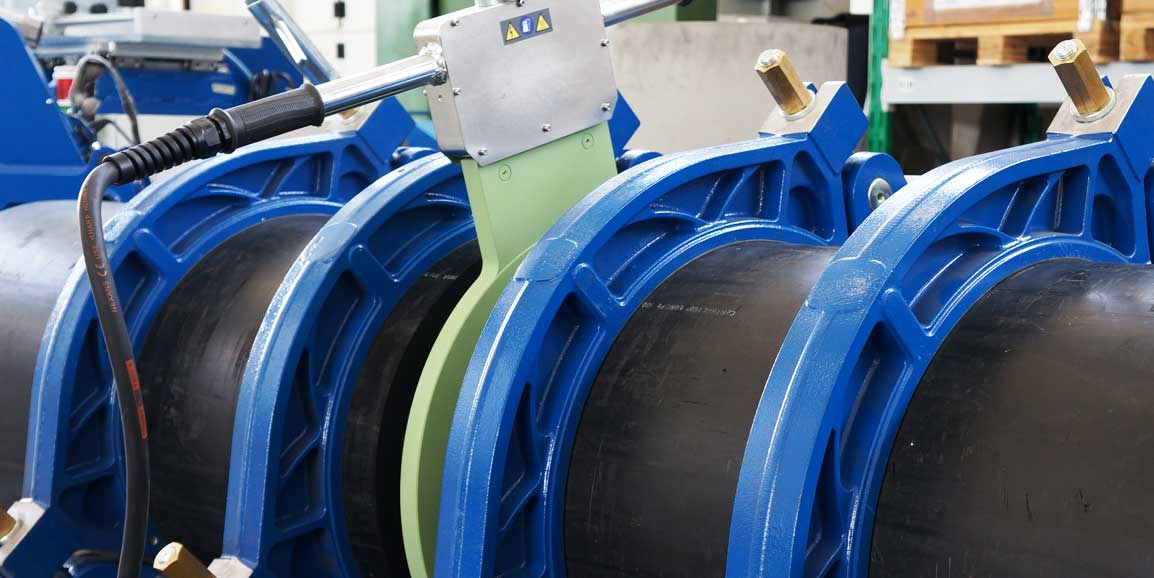
The PT models have been modified to meet the force requirements of high-pressure welding regulations. Modifications of varying degrees have been made, particularly to the base machine and hydraulic unit. The PT 500 model, for example, has been completely redesigned, featuring new (wider) clamps and tie rods, as well as a new, stronger facing tool. In contrast, the base frame of the PT 250 has undergone only minor modifications.
It’s not just a matter of increasing the pressure. The machines must withstand forces three to five times greater without bending or breaking. T2 welding machines have been tested according to the most stringent criteria and at the upper limit of the specified range.
Advanced engineering and careful selection of materials make our machines the best choice in terms of performance, reliability, and durability.
High-pressure welding standards allow for a reduction in cooling time of nearly 50% compared to traditional standards such as DVS. This results in significantly higher productivity!
Email us for more information: info@t2welding.com
[1] ASTM International; ASTM F2620-24 – Standard Practice for Heat Fusion Joining of Polyethylene Pipe and Fittings https://doi.org/10.1520/F2620-20(2020).
[2] A.I. Alhatti et al. 2025: Ahmed I. Alhatti, Suleyman Deveci, Imad Barsoum, Abdelrahman I. Hosny,
Advances in butt fusion jointing of HDPE pipes: A comprehensive review of fusion conditions and joint integrity assessment techniques, in*Polymer Testing*, Vol. 150, Article 108909, available online at:
https://doi.org/10.1016/j.polymertesting.2025.108909(Accessed May 15, 2026).
[3] German Welding Society (DVS) DVS 2207-1 –Welding of Thermoplastics – Heated Tool Welding of Pipes, Pipeline Components, and Sheets Made of PE-HD(2005).
[4] U.K. Water WIS 4-32-08 Issue 4:Specification for the Fusion Jointing of Polyethylene Pressure Pipeline Systems Using PE80 and PE100 Materials, London, United Kingdom (2016), available online at:
https://standards-board.water.org.uk/document/wis-4-32-08-issue-4-specification-for-the-fusion-jointing-of-polyethylene-pressure-pipeline-systems-using-pe80-and-pe100-materials/(Accessed May 15, 2026).
The European Plastic Pipes & Fittings Association (TEPPFA),Butt Fusion Jointing of Polyethylene Pressure Pipes, Brussels, available online at:
https://www.teppfa.eu/wp-content/uploads/Butt-Fusion-Jointing-of-Polyethylene-Pressure-Pipes.pdf(2021) (Accessed May 15, 2026).
[5] The European Plastic Pipes & Fittings Association (TEPPFA),Butt Fusion Jointing of Polyethylene Pressure Pipes, Brussels, available online at:
https://www.teppfa.eu/wp-content/uploads/Butt-Fusion-Jointing-of-Polyethylene-Pressure-Pipes.pdf(2021) (Accessed May 15, 2026).
[6] Standardization Administration of China. GB/T 32434-2015;Plastics Pipes and Fittings—Butt Fusion Jointing Procedures for Polyethylene (PE) Pipes and Fittings Used in the Construction of Gas and Water Distribution Systems(2015).
[7] International Organization for Standardization ISO 21307:2017,Plastics pipes and fittings—Butt fusion jointing procedures for polyethylene (PE) piping systems, available online at:
https://www.iso.org/standard/63773.html#amendment(2017) (Accessed May 15, 2026).
